RRB Group D Exam at a Glance
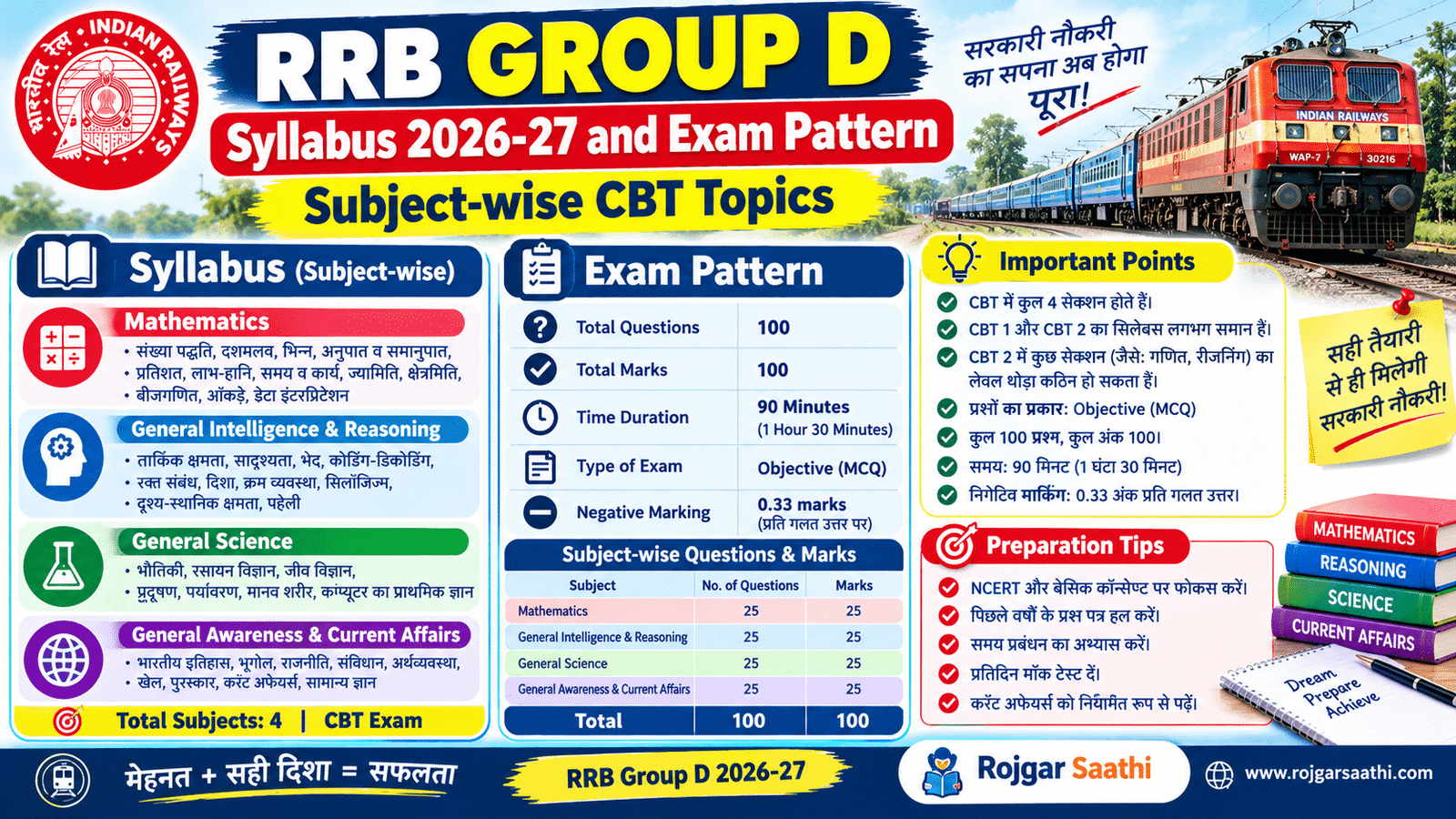
| Particulars | Details |
|---|---|
| Exam | RRB Group D, computer-based test (CBT) |
| CBT | 100 questions, 100 marks, 90 minutes |
| Subjects | Mathematics, General Intelligence and Reasoning, General Science, General Awareness and Current Affairs |
| Question type | All questions are objective type (MCQ) |
| Marking | 1 mark for each correct answer. 1/3 mark is cut for each wrong answer |
| Science level | Class 10 level |
RRB Group D Exam Pattern
The paper is online and objective type, with four subjects. Every question carries 1 mark, so the questions and the marks are the same.
| Subject | CBT Questions | CBT Marks |
|---|---|---|
| General Intelligence and Reasoning | 30 | 30 |
| General Science | 25 | 25 |
| Mathematics | 25 | 25 |
| General Awareness and Current Affairs | 20 | 20 |
| Total | 100 | 100 |
| Time | 90 minutes | |
RRB Group D Syllabus
The topics for all four subjects are given in the table below.
| Subject | Topics |
|---|---|
| Mathematics 25 marks |
Number system, BODMAS, decimals, fractions, LCM and HCF, ratio and proportion, percentages, mensuration, time and work, time and distance, simple and compound interest, profit and loss, algebra, geometry, trigonometry, elementary statistics, square root, age calculations, calendar and clock, pipes and cistern. |
| General Intelligence and Reasoning 30 marks |
Analogies, alphabetical and number series, coding-decoding, mathematical operations, relationships, syllogism, jumbling, Venn diagram, data interpretation and sufficiency, conclusions and decision making, similarities and differences, analytical reasoning, classification, directions, statement: arguments and assumptions. |
| General Science 25 marks, class 10 level |
Physics: motion, force, work and energy, heat and thermodynamics, light and optics, electricity and magnetism. Chemistry: chemical reactions and equations, acids, bases and salts, metals and non-metals, carbon and its compounds. Biology: life processes, human body and health, nutrition and diseases, environment and ecology. |
| General Awareness and Current Affairs 20 marks |
Current affairs (national and international), Indian history and freedom struggle, geography of India and world, Indian polity and Constitution, economy and budget, science and technology, sports and important events, awards and honours, books and authors, important days and organisations. |
Which Topics Come More Often
The number in brackets is roughly how many questions come from that topic in past papers. It is only a rough idea and it can change in the next exam, so do not skip any topic fully.
| Subject | Comes often | Comes regularly | Comes less |
|---|---|---|---|
| Mathematics | Simplification (3-4), number system (3-4), algebra (2-3), mensuration (2-3) | Percentage (1-2), interest (1-2), profit and loss (1-2), ratio and proportion (1-2), speed, time and distance (1-2), time and work (1-2), geometry (1-2), trigonometry (1-2), data interpretation (1-2 in total) | Average (0-1), mixture (0-1), age (0-1), progression (0-1), data sufficiency (0-1), elementary statistics (0-1) |
| Reasoning | Puzzle (3-4), series (3-4), arrangement and pattern (2-3), analogy (2-3), statements (2-3 in total) | Classification (1-2), coding-decoding (1-2), direction and distance (1-2), non-verbal reasoning (1-2), seating arrangement (1-2), syllogism (1-2), Venn diagram (1-2) | Blood relations (0-1), clock and calendar (0-1), ordering and ranking (0-1), data sufficiency (0-1) |
| General Science | All three are almost equal: chemistry (8-9), physics (7-9), biology (6-8) | – | – |
| GK and Current Affairs | Polity (2-3) | Modern history (1-2), economy (1-2), Indian geography (1-2), sports current affairs (1-2), state affairs (1-2) | Ancient and medieval history (0-1), world geography (0-1), ecology and environment (0-1), famous people and places (0-1), government schemes (0-1), science and technology (0-1), art and culture (0-1), awards and books (0-1), days and events (0-1), other current affairs topics (0-1 each) |
Tips for the Exam
- Dont ignore Science, Physics Chemistry and Biology all are almost same in size so I suggest you to read class 9 and 10 NCERT books line by line.
- In maths start with simplification and number system first, they come most so make them strong. Then do algebra and mensuration.
- Puzzles and series are the main topics in reasoning so solve some daily. Make a small diagram for seating arrangement so it will be easy.
- In GK start with polity, then modern history, economy and indian geography. These give most static GK questions so finish them before the small topics.
- Read current affairs daily for 15 to 20 min. and give more time to sports and state news because it comes regularly.
- Dont study chapter wise only, after one topic is done solve mixed 20 questions from all subjects because the real paper is not chapter wise.
- In exam attempt science and GA first because they are quick, and use the saved time for maths. After 3 to 4 mocks change this as per your comfort.
- Learn tables up to 20, squares up to 30, cubes up to 15 and percentage values like 1/3 = 33.33%, 1/6 = 16.67%, 1/8 = 12.5% so that you can calculate fast. Also remember alphabet positions and leap year rule.
- Mistakes which students do are skipping science, wasting too much time on one puzzle, giving mocks but not checking wrong answers and starting new topics in last 3 days.
- In last 15 days give one mock daily for first 10 days and check your mistakes for 1 to 2 hours. Revise formulas, science notes and GK notes daily. In last 4 days only revise, no new topic, and sleep well before the exam.
Common Questions
How many questions are there in the Group D CBT?
There are 100 questions of 1 mark each, and the time is 90 minutes.
How many marks does each subject carry?
General Science 25, Mathematics 25, General Intelligence and Reasoning 30, and General Awareness and Current Affairs 20.
Is there negative marking?
Yes, 1/3 mark is deducted for every wrong answer.
What is the level of the Science syllabus?
It is class 10 level and covers Physics, Chemistry and Biology.
Which maths topics come most often?
Simplification and Number System come most, followed by Algebra and Mensuration.
Are the topic wise numbers fixed?
No. They are a rough idea from past papers, and the number of questions from a topic can change.