
UPSSSC PET Exam at a Glance
| Particulars | Details |
|---|---|
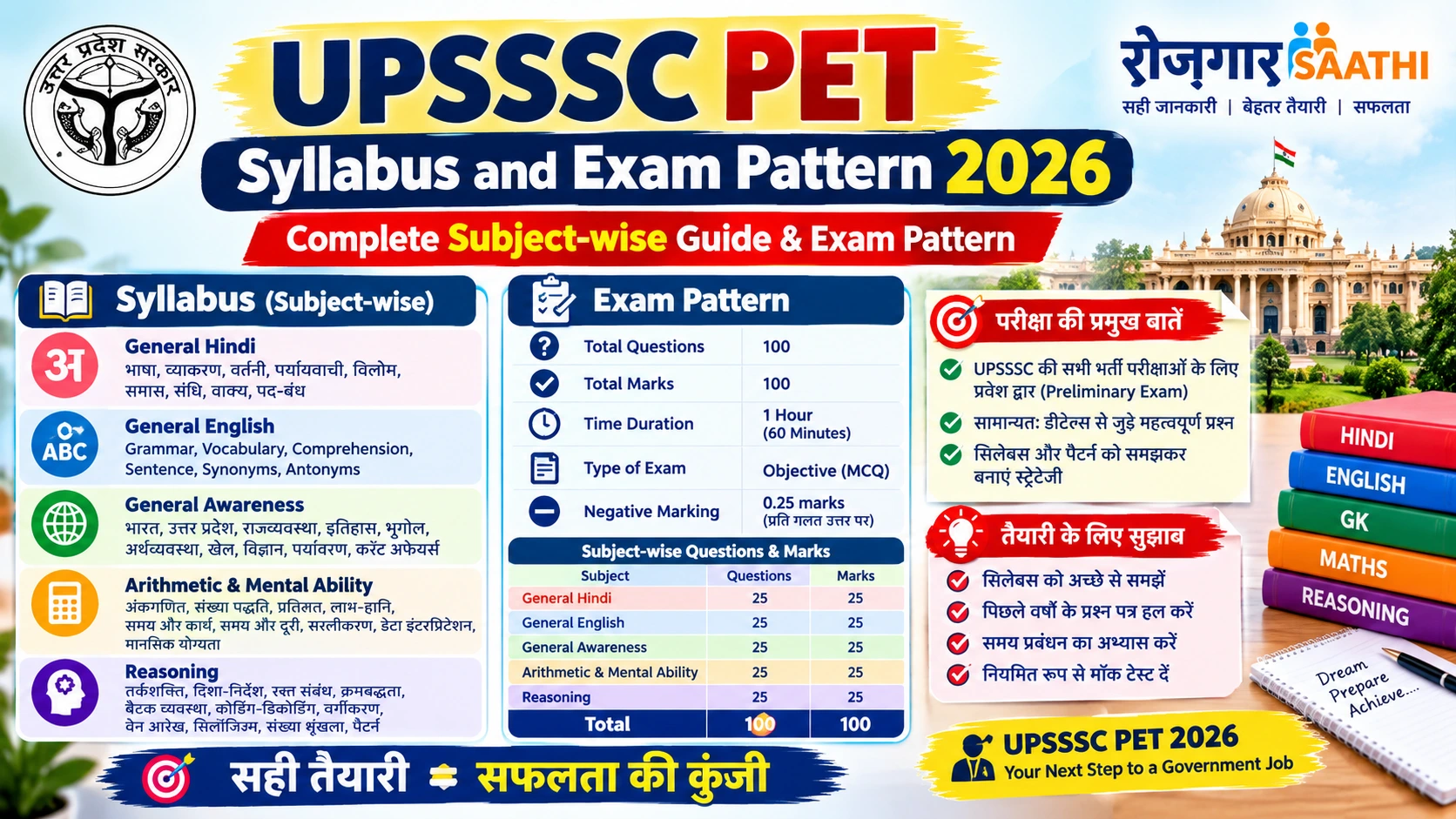
| Exam | UPSSSC PET (Preliminary Eligibility Test), computer or OMR based objective test |
| Total questions | 100 (multiple choice) |
| Total marks | 100 (1 mark for every question) |
| Total time | 2 hours |
| Negative marking | 1/4 mark is cut for each wrong answer |
| Sections | History, Geography, Indian Economy, Constitution, General Science, Arithmetic, Hindi, English, Reasoning, Current Affairs, General Awareness, and Hindi passage, graph and table analysis |
UPSSSC PET Exam Pattern
Every question is MCQ type and carries 1 mark, so the number of questions and the marks are the same for each section. The paper is one test of 100 questions.
| Section | Questions | Marks | Details |
|---|---|---|---|
| Hindi passages | 10 | 10 | 2 passages, 5 questions each |
| Graph analysis | 10 | 10 | 2 graphs, 5 questions each |
| Table analysis | 10 | 10 | 2 tables, 5 questions each |
| Current Affairs | 10 | 10 | National and international events |
| General Awareness | 10 | 10 | |
| History and National Movement | 10 | 10 | Ancient and medieval 5, modern and freedom struggle 5 |
| Geography | 5 | 5 | |
| Indian Economy | 5 | 5 | |
| Constitution and Public Administration | 5 | 5 | |
| General Science | 5 | 5 | |
| Elementary Arithmetic | 5 | 5 | |
| General Hindi | 5 | 5 | |
| General English | 5 | 5 | |
| Logic and Reasoning | 5 | 5 | |
| Total | 100 | 100 |
UPSSSC PET Syllabus
The topics for all the sections are given in the table below.
| Subject | Topics |
|---|---|
| Passages, graphs and tables 30 marks |
Hindi passages (2 passages, 5 questions each), graph analysis (2 graphs, 5 questions each) and table analysis (2 tables, 5 questions each). The answers are based on the data given in the question itself. |
| History and National Movement 10 marks |
Ancient and medieval (5 marks): Indus Valley, Vedic culture, Buddhism, Jainism, Maurya, Gupta, Harshvardhan, Rajput period, Delhi Sultanate, Mughals, Marathas.
Modern and freedom struggle (5 marks): rise of British rule and 1857, effects of British rule, early freedom movement, Swadeshi and Civil Disobedience, revolutionary movement, Government of India Act 1935, Quit India Movement, Azad Hind Fauj and Netaji. |
| Geography 5 marks |
Physical geography of India and world, rivers and valleys, groundwater, mountains and glaciers, deserts and dry areas, mineral resources, political geography, climate and weather, time zones, population and migration. |
| Indian Economy 5 marks |
Economy 1947 to 1991, Planning Commission and Five-Year Plans, mixed economy, Green Revolution, Operation Flood, bank nationalisation, 1991 reforms, reforms after 2014, agricultural reforms, structural and labour reforms, financial reforms, GST. |
| Constitution and Public Administration 5 marks |
Indian Constitution, salient features, Directive Principles, Fundamental Rights and Duties, parliamentary system, federal system and Union Territories, Union-State relations, Supreme Court and High Court, district administration, local bodies and Panchayati Raj. |
| General Science 5 marks |
Basic physics, basic chemistry and basic biology. Questions are up to class 12 level. |
| Elementary Arithmetic 5 marks |
Whole numbers, fractions, decimals, percentage, simple equations, squares and square roots, powers, average. |
| General Hindi 5 marks |
संधि, विलोम शब्द, पर्यायवाची, वाक्यांशों के लिए एक शब्द, लिंग, समश्रुत भिन्नार्थक शब्द, मुहावरे और लोकोक्तियां, सामान्य अशुद्धियां, लेखक और रचनाएं। |
| General English 5 marks |
English grammar, unseen passage. |
| Logic and Reasoning 5 marks |
Comparison, order and ranking, blood relations, classification, calendar and clock, cause and effect, statement and assumption, statement and conclusion, statement and argument, coding-decoding, negative reasoning, syllogism, inequality, dice and cube, Venn diagram, data sufficiency, puzzle test, series, direction and distance. |
| Current Affairs 10 marks |
National events and international events. |
| General Awareness 10 marks |
Neighbouring countries, capitals and currencies, states and UTs, Parliament (Lok Sabha, Vidhan Sabha and Parishad), important days, world organisations and headquarters, tourist places, art and culture, sports, research organisations, books and authors, awards, climate and environment. |
Tips for the Exam
- Here are some useful tips and insights which might help you to get good marks in exam:
- In this exam you get 30 marks form hindi passages, graphs, tables, and data questions, so I suggest you to practice this type of questions daily so that you get speed and you can get better in solving this type of questions
- I suggest you to make a small notebook for GK where you write capitals, organisations, awards and important info. and should revise it every week so that you dont forget it.
- In GK constitution, panchayati raj and local bodies are important info. which may link to UP gov. posts so it might be asked in the exam so learn the well.
- Hindi and reasoning are small small topics so solve some questions daily so it will be in practice.
- I suggest you to give mock tests which will show you your real progress and you can get a better understanding of the how the exam is and where you stand.
- The pattern can change with a notice, so keep checking the official website.
Common Questions
How many questions come in UPSSSC PET?
There are 100 questions of 1 mark each, and you get 2 hours.
Is there minus marking?
Yes, 1/4 mark is cut for every wrong answer.
Which sections have the most marks?
Current Affairs, General Awareness, History, Hindi passages, graph analysis and table analysis have 10 marks each.
How tough is General Science?
It is up to class 12 level. It has basic physics, chemistry and biology.
Is English compulsory in PET?
Yes. There are 5 questions on English grammar and an unseen passage.
How many questions come from graphs and tables?
There are 20 questions, 10 from two graphs and 10 from two tables.
What comes in Elementary Arithmetic?
Whole numbers, fractions, decimals, percentage, simple equations, squares and roots, powers and average.

1 Comment